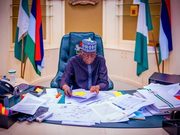








President Bola Tinubu has requested legislative approval for fresh external borrowing to finance infrastructure, agriculture, healthcare, education, security and employment programmes across Nigeria.
President Bola Tinubu has asked the House of Representatives to approve external loan facilities totalling $20.52bn and €1.045bn under the Federal Government’s 2026–2027 Supplementary External Borrowing Rolling Plan.
The proposed borrowing is intended to fund development projects and programmes covering infrastructure, agriculture, healthcare, education, water supply, security and employment generation, among other priority areas.

The President’s request was presented in a letter read by the Speaker of the House of Representatives, Tajudeen Abbas, during Wednesday’s plenary session.
In the correspondence, Tinubu urged lawmakers to consider the proposal expeditiously, arguing that legislative approval would enable the government to proceed with its planned interventions.
The President put the total proposed facilities at $20,517,755,901 and €1,045,083,643. He added that a detailed breakdown of the proposed loans had been submitted to the House for consideration.

Tinubu Explains Reasons for Additional Borrowing
Explaining the rationale behind the request, Tinubu said additional external financing was necessary to support the administration’s reform agenda and accelerate economic growth.
According to the President, the proposed projects were selected after technical and economic assessments, with consideration given to their expected contributions to national development.
He said the planned interventions were designed to create employment opportunities, encourage skills acquisition and entrepreneurship, reduce poverty and strengthen food security.
Tinubu also disclosed that most of the projects and programmes would be implemented across Nigeria’s 36 states and the Federal Capital Territory.
The administration maintains that the proposed financing would help address critical development needs and support programmes intended to improve economic opportunities for Nigerians.
Infrastructure Deficit Drives Loan Request
The President identified Nigeria’s infrastructure deficit as a major reason for seeking additional external financing, noting that the scale of investment required to close the gap exceeds the resources currently available to the government.
Tinubu argued that borrowing, if prudently managed, would help bridge the funding shortfall and enable the government to pursue essential development projects.
“In light of the need for significant infrastructure investment in the country and the vast financial resources needed to address this gap, it has become essential to pursue prudent external borrowing to close the financial shortfall,” he said.
He explained that the proposed facilities would support critical infrastructure, particularly in the power, transportation and healthcare sectors.
The President also emphasised the importance of timely disbursement and effective implementation to ensure that the planned projects deliver their intended benefits.
He urged lawmakers to approve the request without unnecessary delay, saying the financing would help the government meet its commitments and accelerate the execution of development programmes.
House Refers Proposal to Joint Committees
Following the presentation of the presidential letter, the House of Representatives referred the borrowing request to a joint committee comprising the Committee on Aids, Loans and Debt Management and the Committee on Appropriations.
The joint committee is chaired by Abubakar Nalaraba and is expected to examine the proposal before reporting back to the House for further legislative action.
The review will provide lawmakers with an opportunity to assess the proposed facilities, their intended uses, the terms of the loans and their potential implications for Nigeria’s public finances.
The referral means the borrowing proposal has not yet received final approval from the House of Representatives.
The government must complete the required legislative process before proceeding with the loan facilities covered by the request.
Borrowing Plan Raises Questions About Development Financing
The proposed external borrowing comes amid ongoing discussions about how Nigeria can finance its infrastructure and development priorities while managing its public debt obligations.
The Federal Government has identified investment in infrastructure, social services, food security and employment generation as important components of its economic development agenda.
However, the proposed facilities will require legislative scrutiny to determine whether their terms, financing arrangements and expected benefits justify the additional borrowing.
The outcome of the committee review and subsequent consideration by the House will determine whether the request receives legislative approval.
For now, Tinubu’s proposal remains under consideration, with lawmakers expected to examine the details before deciding on the government’s request for $20.52bn and €1.045bn in external financing.