













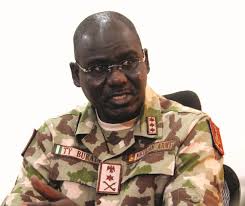
retired lieutenant general tukur yusuf buratai maintains that the $1 billion approved for defence procurement during his tenure was managed by the ministry of defence, calls for greater transparency, while ahmed lawan and defence minister christopher musa advocate stronger funding and intelligence capabilities.
Former Chief of Army Staff (COAS), retired Lieutenant General Tukur Yusuf Buratai, has denied personally handling or receiving any portion of the $1 billion approved by the Federal Government for defence procurement during his tenure, saying the funds were released to the Ministry of Defence rather than the Nigerian Army, Navy or Air Force.
Buratai made the clarification while addressing the longstanding controversy surrounding the defence procurement funds. He said the money was approved by the National Economic Council (NEC) and that the Ministry of Defence was responsible for administering the procurement process.

According to the retired army chief, neither he personally nor the three military services received the funds directly for procurement purposes.
“The $1 billion was approved by the National Economic Council, NEC, for defence procurement. Not a single dollar of that fund passed through my hands or through the accounts of the Nigerian Army, Navy, or Air Force,” he said.
He maintained that the Ministry of Defence handled the process, including the management of the funds and procurement arrangements.

Buratai Calls Allegations Political and Malicious
The former army chief described allegations surrounding the $1 billion defence procurement allocation as politically motivated and malicious.
He said the controversy emerged during the 2019 general election, when opposition figures alleged that the money had been diverted to support electoral activities.
Buratai stated that the Federal Government publicly rejected the allegations at the time. However, he argued that the controversy continued to damage the reputations of military service chiefs, even though, according to him, the military services did not directly manage the funds.
He criticised the Ministry of Defence for not publicly providing a detailed account of how the money was disbursed or how procurement contracts were awarded.
“The ministry, since then on its own, had not publicly explained how the funds were disbursed or contracts awarded. Accountability must be properly located,” he said.
Buratai argued that questions about the expenditure should be addressed by the institution responsible for managing the funds.
Ex-Army Chief Proposes Defence Procurement Transparency Portal
To improve public accountability, Buratai called for the establishment of a Defence Procurement Transparency Portal through which relevant information about military procurement could be made available to the public.
He proposed that the platform should disclose broad categories of contracts awarded, the companies or entities receiving the contracts, and expected delivery timelines, while withholding information that could compromise national security.
“The Ministry of Defence must own procurement record. The $1 billion arms procurement controversy festered because the institution that managed the funds, the Ministry of Defence, remained silent while service chiefs absorbed criticism,” he said.
He added that the proposed portal would help the public understand how defence procurement funds were spent and which institutions were responsible for the transactions.
Buratai also recommended quarterly accountability bulletins summarising the outcomes of court-martial proceedings involving alleged human rights violations and operational misconduct.
He said such disclosures should be carefully managed to protect the rights of accused military personnel and avoid interfering with ongoing operations.
Buratai Says Human Rights Allegations Must Be Investigated
The retired general also addressed allegations of human rights abuses by members of Nigeria’s security forces, insisting that credible claims should be investigated and prosecuted where the evidence supports criminal charges.
“I have always maintained that where credible allegations exist, they must be investigated and, where substantiated, prosecuted. The military is not above the law,” he said.
He stressed that the Armed Forces must demonstrate that their internal disciplinary systems are credible, transparent and capable of addressing misconduct at all levels.
Buratai further called for improved communication by the military and the Ministry of Defence, arguing that clearer public information could help address concerns and provide context for media reports about security operations.
Ahmed Lawan Advocates Dedicated Security Funding
Meanwhile, former Senate President and Chairman of the Senate Committee on Defence, Senator Ahmed Lawan, called for a dedicated percentage of Nigeria’s revenue to be allocated to the Armed Forces and other security agencies.
Lawan said a predictable funding arrangement would help the security services acquire additional military platforms, equipment and other resources needed to tackle the country’s security challenges.
He maintained that the National Assembly had consistently supported requests for funding from the executive arm of government for the military and other security institutions.
“For us in the National Assembly, it is our duty to support the arm of government, to ensure that whatever resources are available and are required by the arm of government, we support that and we even give more,” he said.
Lawan, who said he had spent more than 27 years in the National Assembly, maintained that requests submitted by the executive for the Armed Forces and other security agencies had not been rejected during his legislative experience.
He added that lawmakers considered national security a major priority when reviewing requests for resources.
Defence Minister Calls for Intelligence and Technology Improvements
Minister of Defence, retired General Christopher Musa, also highlighted the increasingly complex nature of Nigeria’s security challenges, calling for improvements in intelligence gathering, technology, operational planning and coordination among security institutions.
Musa, who was represented by his Senior Special Assistant on Foreign Relations, retired Air Commodore Steven Ogunmodede, said terrorist groups, criminal networks and other hostile actors were exploiting technology, financial systems, information and weaknesses in coordination to advance their activities.
He argued that an effective response required more than combat operations, emphasising the importance of reliable intelligence, careful planning and cooperation among the institutions responsible for national security.
According to the minister, intelligence-led operations enable security agencies to detect threats early, understand the networks behind criminal and terrorist activities, assess their intentions and respond before attacks occur.
Musa Says Technology Must Support Military Expertise
The defence minister also stressed that technology could strengthen military surveillance, reconnaissance, communications and intelligence analysis.
However, he cautioned that technological investments would only deliver meaningful results when combined with trained personnel, dependable equipment, appropriate operational procedures and professional judgement.
“Technology is a force multiplier, it does not replace the human judgement, discipline and professional competence upon which military effectiveness ultimately depends,” he said.
Musa stated that the Ministry of Defence and the Armed Forces of Nigeria were pursuing approaches intended to improve situational awareness, intelligence coordination and operational performance.
He urged security institutions to continue adapting to emerging threats and ensuring that investments in technology translated into practical improvements in protecting lives and safeguarding the country’s territorial integrity.
The minister also called for stronger collaboration across Nigeria’s security architecture, noting that no single institution possessed all the intelligence, resources and operational capabilities required to address the country’s security problems.
Accountability and Security Funding Remain Key Issues
The statements by Buratai, Lawan and Musa highlight several issues in Nigeria’s defence sector, including transparency in procurement spending, adequate funding for security agencies, human rights accountability and the effective use of intelligence and technology.
While Buratai maintains that the Ministry of Defence controlled the disputed $1 billion allocation, his call for greater disclosure places renewed emphasis on the need to identify the institutions responsible for managing public defence expenditure.
His claims about the handling of the funds, however, represent his account of the procurement arrangement. The supplied report does not include an independent breakdown of the money’s disbursement, the contracts awarded or the equipment delivered.


